Yokohama
Around the World in Eighty DaysYokohama is the Pacific port where a missed connection, an improvised voyage, and a chance encounter bring Phileas Fogg’s separated party together again. For Passepartout it is first an unfamiliar city in which he has no money and no master; for Fogg it is a crucial transfer point, where the delay accumulated on the route from Hong Kong can still be contained by the onward sailing to San Francisco.
Port and position on the route
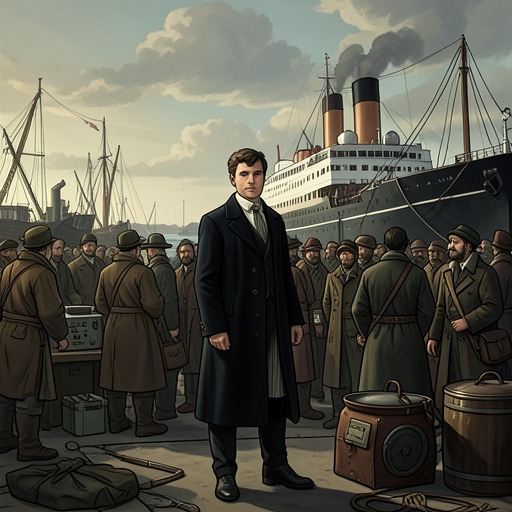
The narrative presents Yokohama as an important port of call in the Pacific, serving mail steamers and travellers moving between North America, China, Japan, and the islands of the Orient. It lies in the bay of Yeddo, close to the Japanese Empire’s second capital, and its quay is crowded with ships flying many nations’ flags. This international maritime setting gives the city a practical importance in the journey: it is not merely a destination to be seen, but a place where the party’s progress depends on ships arriving and departing in sequence.
The city’s European quarter offers one view of that traffic and exchange. Its low-fronted houses have verandas and glimpses of neat peristyles, while streets, squares, docks, and warehouses fill the area between the Treaty promontory and the river. Americans, English people, Chinese, and Dutch people mingle there, described as merchants ready to buy or sell. The quarter makes Yokohama legible to a traveller arriving from Hong Kong or Calcutta, yet it does not make the city familiar to Passepartout: amid the mixed crowds, he feels profoundly alone.
A connection threatened by delay
Fogg’s timetable makes Yokohama important well before he reaches it. After leaving Singapore aboard the Rangoon, he hopes to complete the passage in six days and catch the steamer scheduled to leave Yokohama for San Francisco on November 6. At Hong Kong, he asks the pilot when a ship will sail for Yokohama and learns that one is due to depart at high tide the following morning. The timing depends on the connection from Hong Kong, not simply on Fogg’s own speed.
The Carnatic’s boiler repairs unexpectedly alter the situation. Had the ship not been held for repairs, it would have sailed on November 6, leaving passengers bound for Japan to wait a week for the next departure. Instead, its delay preserves the connection. Fogg is nevertheless twenty-four hours behind schedule, thirty-five days after leaving London. The Hong Kong-to-Yokohama steamer links directly with the Pacific crossing: the latter cannot sail until the former arrives, and Fogg expects the twenty-two-day voyage across the Pacific to make up the lost day. Yokohama is therefore both a threatened deadline and a point where the larger timetable can absorb some delay.
Passepartout arrives alone
At dawn on November 13, the Carnatic enters Yokohama. Passepartout has travelled aboard it without Fogg or Aouda, and his passage has fortunately been paid in advance. His situation is otherwise precarious: he has no money, not even a penny, and does not know what he will do after reaching Japan. With five or six days before he must decide on a course, he goes ashore and wanders without a plan, taking chance as his guide.
His first exploration remains within the European quarter, among its houses, docks, warehouses, and international crowds. But that commercial bustle provides no immediate help. Hungry and alone, he considers selling his watch, then decides he would rather starve than part with it. Instead, he plans to earn food by singing French and English songs, reasoning that Japanese listeners might value music. He also realizes that his European clothes do not suit the appearance of a wandering performer. His search for a second-hand clothing dealer begins as a response to hunger and the need to make himself presentable for a different kind of work. Yokohama thus becomes the setting for an abrupt change in his circumstances: the servant who had been part of Fogg’s carefully organized journey must improvise for himself.
Fogg’s arrival and the reunion
Fogg reaches Yokohama on the morning of November 14, a day after Passepartout. He has come with Aouda and Fix aboard the Tankadere, after the party’s search for a craft willing to sail from Hong Kong. Fogg pays John Bunsby the agreed passage price and gives him an additional five hundred and fifty pounds. On reaching Yokohama, Fogg goes straight aboard the Carnatic and learns, to Aouda’s delight, that Passepartout had arrived the previous day. Fogg betrays little emotion, but the news means that the separated party has not lost its onward connection.
Time is short: the steamer for San Francisco is due to leave that very evening. Fogg first seeks Passepartout through the French and English consuls, without success, then spends a long time searching the streets. The city’s international institutions cannot locate his servant; the eventual reunion comes through coincidence rather than official assistance. Chance, or what the narration calls a kind of presentiment, leads Fogg to William Batulcar’s theatre. Fogg cannot recognize Passepartout in the performer’s eccentric costume. Passepartout, lying on his back in the gallery’s view, recognizes his master; his startled movement shifts his nose and brings the staged human pyramid tumbling onto the stage. The theatrical collapse turns a disguise into a signal, ending the separation in the middle of a performance.
Transfer point and narrative function
Yokohama gathers together several different forms of movement: the scheduled passage of the Carnatic, the delayed but connected Pacific steamer, the Tankadere’s emergency voyage, and Passepartout’s aimless wandering through the city. Its docks and ships make long-distance travel possible, but the narrative also shows that a timetable alone cannot reunite the travellers. Fogg must search in person, while Passepartout’s recognition—and his involuntary disruption of the performance—makes the reunion visible.
The city’s role is brief but decisive. The party must find Passepartout before the San Francisco steamer departs, and the theatre encounter restores the group in time for the next leg of the journey. Yokohama is consequently both a working port within the route and a meeting place where the expedition’s separate strands converge: Fogg’s effort to recover lost time intersects with Passepartout’s struggle to manage without money or guidance.